
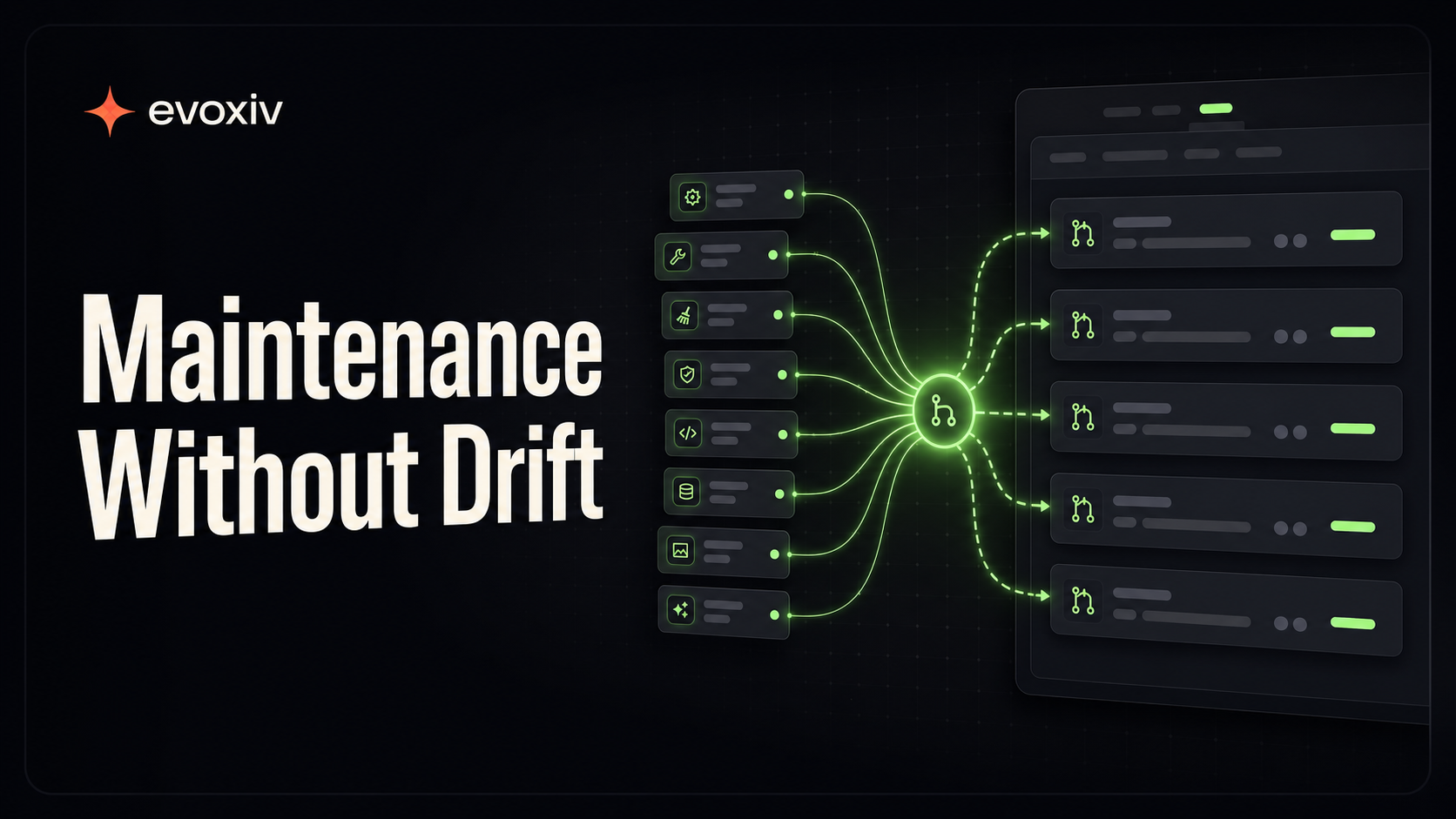
AI Agents for Software Maintenance: Stop Letting Small Work Drift
Software maintenance rarely fails all at once. It drifts.
A dependency warning waits for the next sprint. A flaky test gets mentioned in a thread. A small accessibility issue is real but not urgent. A customer-facing copy fix is simple enough that everyone assumes someone will grab it later. None of these tasks look strategic on their own, so they collect in the spaces between roadmap work.
That is where many product teams quietly lose momentum. The backlog does not only contain big bets and new features. It also contains the small repairs that keep a product fast, trustworthy, and easy to change. When those repairs wait too long, every future change becomes slightly more expensive.
AI agents for software maintenance are useful because they can turn that low-drama work into a steady operating rhythm. Not a chaotic burst of generated patches. Not a magic button that bypasses review. A visible system where small maintenance Stories are scoped, assigned, implemented, verified, and handed to a reviewer with the evidence attached.
That is the maintenance workflow evoxiv is built to support: keep the backlog from becoming a museum of good intentions.
Why software maintenance becomes expensive
Technical debt is often described like a big architectural problem. Sometimes it is. More often, it is a long list of tiny unclosed loops.
A team ships a feature and says, "We should clean up that helper next week." A design tweak lands and someone notices the mobile state could be better. A test fails once in CI, passes on rerun, and earns a shrug. A dependency releases a security patch that looks straightforward but still needs someone to read the changelog, make the update, run checks, and open the pull request.
The problem is not that developers ignore quality. The problem is that good maintenance work competes poorly for attention. It is important enough to matter, but not always dramatic enough to interrupt roadmap pressure.
Over time, these small delays compound:
- Reviews take longer because the surrounding code is harder to trust.
- Releases feel riskier because old warnings blur with new ones.
- Customer polish waits behind feature work even when the fix is simple.
- Engineers carry more context in their heads because the tracker is stale.
- Managers ask for status because maintenance work has no visible owner.
This is the real cost of backlog drift. It is not just a longer task list. It is lower confidence in the system.
The missing layer is operational ownership
Many teams already use AI coding tools for individual moments: explain this file, write this test, draft this component, update this function. Those moments can help, but they do not solve the maintenance problem by themselves.
Maintenance requires operational ownership. Someone has to decide what counts as a unit of work, where it should be tracked, who is responsible for it, what checks prove it is safe, and how the reviewer receives context.
That is why an AI agent workflow is different from a code suggestion. A useful autonomous coding agent does not only produce a diff. It follows the surrounding engineering ceremony that makes the diff acceptable:
- Capture the request as a durable Story.
- Read the relevant code and existing conventions.
- Make a tightly scoped change.
- Run the appropriate checks.
- Open a pull request.
- Summarize what changed and what still needs human judgment.
For software maintenance, that surrounding ceremony is the whole point. The work is often small, but the trust boundary is not. A dependency bump, lint cleanup, regression test, broken link fix, or UX polish pass still deserves reviewable evidence.
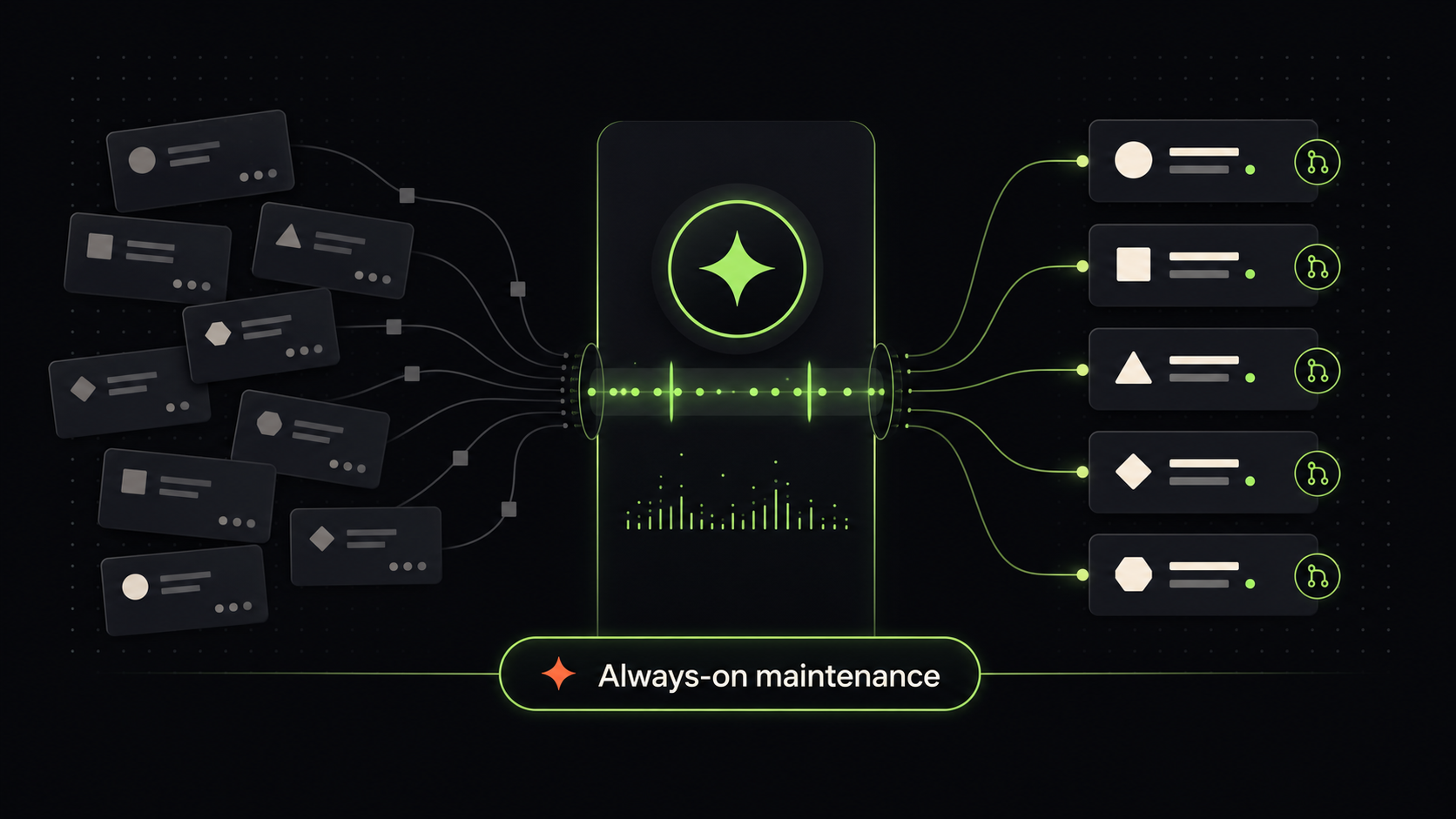
Always-on does not mean unsupervised
The phrase "always-on AI agents" can sound risky if it implies agents making endless changes without human control. That is not the useful model.
The useful model is closer to an always-available execution layer. A product lead, founder, engineer, or scheduled workflow identifies a maintenance Story. The agent handles the repetitive path from request to pull request. A human still reviews the final artifact before it ships.
That distinction matters for teams evaluating AI software agents. Speed is valuable only when the work remains legible. If an agent creates unexplained churn, it increases review load. If it turns small maintenance items into scoped, tested pull requests with clean summaries, it reduces coordination load.
In evoxiv, a Story gives the work a visible home. The agent is not just answering a prompt in isolation. It is operating inside a workflow where status, context, verification, and review can be inspected.
That is what keeps maintenance automation from becoming noise.
Good maintenance Stories are small and specific
The best maintenance work for an AI agent is not vague. "Clean up the codebase" is too broad. "Update the billing settings empty state to match the new copy and add a regression test" is a unit of work.
Strong maintenance Stories tend to share a few traits:
- The expected outcome can be described in plain language.
- The affected area is discoverable from the repo or product context.
- The change can be verified with a focused check.
- The risk is small enough for a reviewer to evaluate quickly.
- The result should be a pull request, not an informal patch.
That makes maintenance a strong fit for agentic software development. The work is real, but much of the overhead is procedural: find the convention, make the change, run the check, write the summary, attach the pull request.
A developer can do all of that. The question is whether the developer should spend their best attention on every small loop, every time.
Examples of maintenance work agents can carry
AI agents are not only for big feature builds. In many teams, the highest-leverage use cases are the tasks that are too important to ignore and too repetitive to protect manually forever.
Examples include:
- Adding regression tests for recently fixed bugs.
- Updating stale documentation after a merged implementation.
- Fixing broken links, empty states, and small UI inconsistencies.
- Applying safe dependency updates with focused test runs.
- Retiring dead flags or old configuration paths.
- Tightening validation around edge cases discovered in support.
- Converting repeated review comments into lint rules or helper functions.
- Sweeping accessibility issues that have clear acceptance criteria.
None of these should bypass engineering standards. That is the point. The agent should follow the standards so the team can keep moving without lowering them.
Backlog automation should make review easier
A bad automation system says, "Here are more changes to inspect."
A good AI agent workflow says, "Here is the request, here is the focused change, here are the checks, here are the caveats, and here is the pull request."
That difference is why review context matters so much. Maintenance work often touches shared surfaces. Even when the diff is small, the reviewer needs to know why the change exists and how it was verified.
For SEO terms like backlog automation, developer productivity tools, AI coding agents, and software delivery automation, this is the substance behind the buzzwords. The value is not that a model can type code. The value is that the workflow reduces the number of human handoffs required to get safe work into review.
If a team can create ten small maintenance Stories and receive ten reviewable pull requests instead of ten open loops, the backlog changes character. It becomes a queue the system can process, not a parking lot for someday.
The product benefit: less drift, more trust
Users rarely notice maintenance directly. They notice its absence.
They notice when a product gets slower to improve. They notice when polish issues linger. They notice when fixes regress. They notice when rough edges survive because every small change has to fight for calendar space.
A steady maintenance workflow protects product quality in a quieter way. It keeps small issues from growing into expensive ones. It gives engineers cleaner surfaces to build on. It gives reviewers better context. It gives product leaders a way to move operational work without turning every minor item into a meeting.
That is where evoxiv fits: a place to turn software work into Stories, dispatch agents, and keep the path to review visible.
How to start using AI agents for maintenance
The practical starting point is simple: stop asking which giant project an agent can own, and start asking which small loops your team keeps reopening.
Look for work that is:
- recurring,
- well-scoped,
- reviewable,
- annoying to coordinate,
- and valuable when completed consistently.
Then write it as a Story. Give the agent enough context to act. Require the same checks you would expect from a teammate. Review the pull request. Keep the successful patterns and schedule the recurring ones.
That is how AI agents become useful infrastructure instead of a novelty layer. They do not remove engineering judgment. They give judgment a cleaner stream of finished work to evaluate.
Software maintenance will never be the loudest part of product development. But it is one of the clearest places where AI agents can create compounding leverage: fewer stale tasks, fewer vague handoffs, more reviewable pull requests, and less drift between what the team knows should happen and what actually ships.
That is maintenance without drift.