
Every software team has met the sentence that sounds harmless and ruins the afternoon:
"Can we make one small change before this ships?"
The request is rarely malicious. Usually it is a real customer edge case, a clearer label, a missing validation rule, or a workflow detail that someone finally noticed because the feature is close enough to inspect. The problem is not the change itself. The problem is everything around it: context is scattered, ownership is fuzzy, checks are implied, and review starts with a detective story.
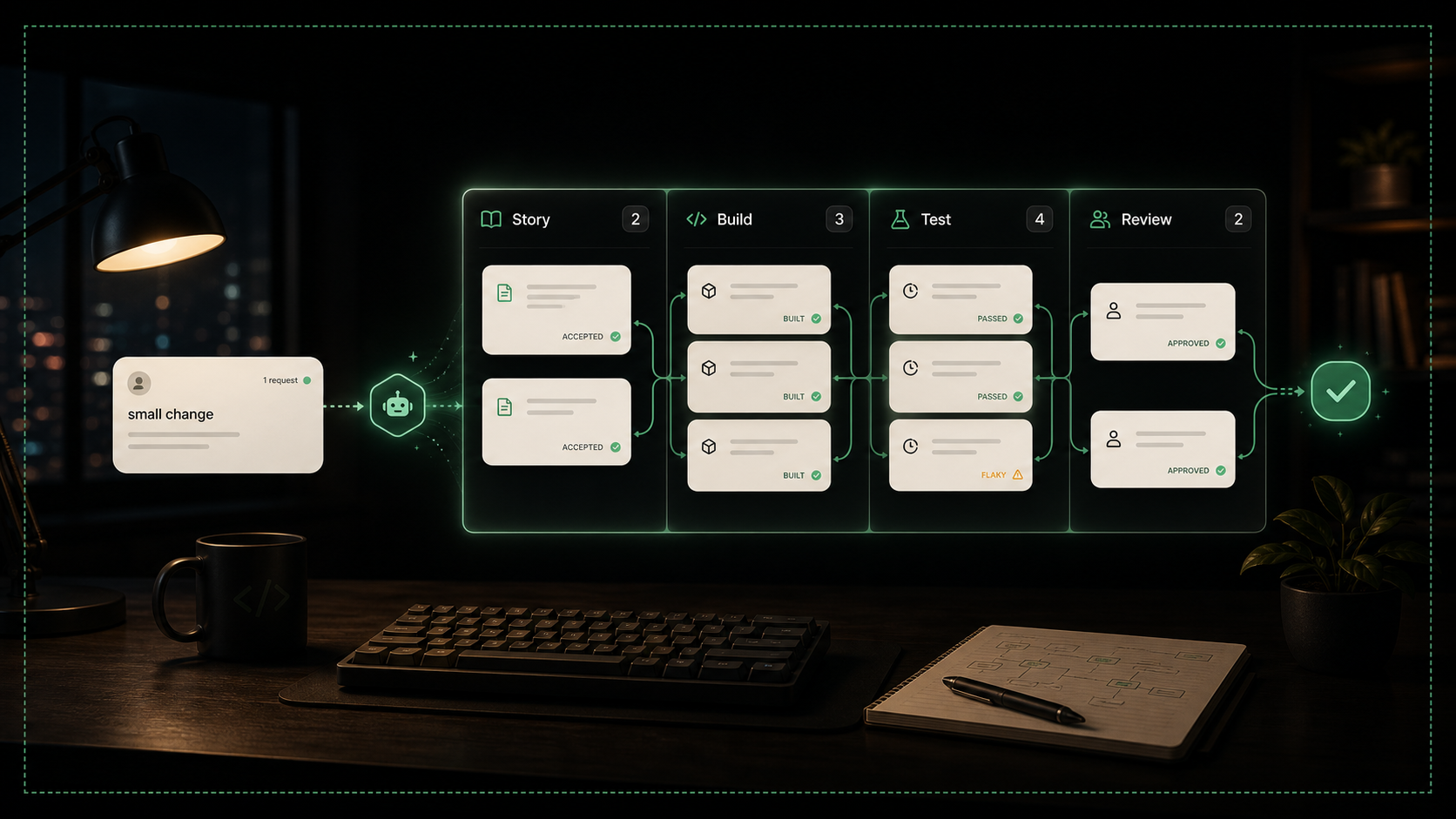
That is why AI agents for software teams are most useful when they do more than write code. A good agentic workflow turns the "small change" into a visible unit of work: scoped, assigned, tested, summarized, and ready for review.
In other words, the win is not replacing developers. The win is replacing the vague handoff.
The anatomy of a tiny request
Here is how the tiny request usually grows when there is no structured workflow:
- Someone asks for the change in a thread.
- Another person asks which branch or feature it belongs to.
- A developer remembers there is related validation in another file.
- A reviewer asks whether the edge case is covered.
- Someone reruns the build.
- The original requester asks whether it shipped.
None of these steps are dramatic. That is exactly why they are expensive. Small coordination costs hide in plain sight because each one looks reasonable in isolation.
For a modern product team, the question is not "can AI write this patch?" The better question is:
Can the system make the work legible from request to review?
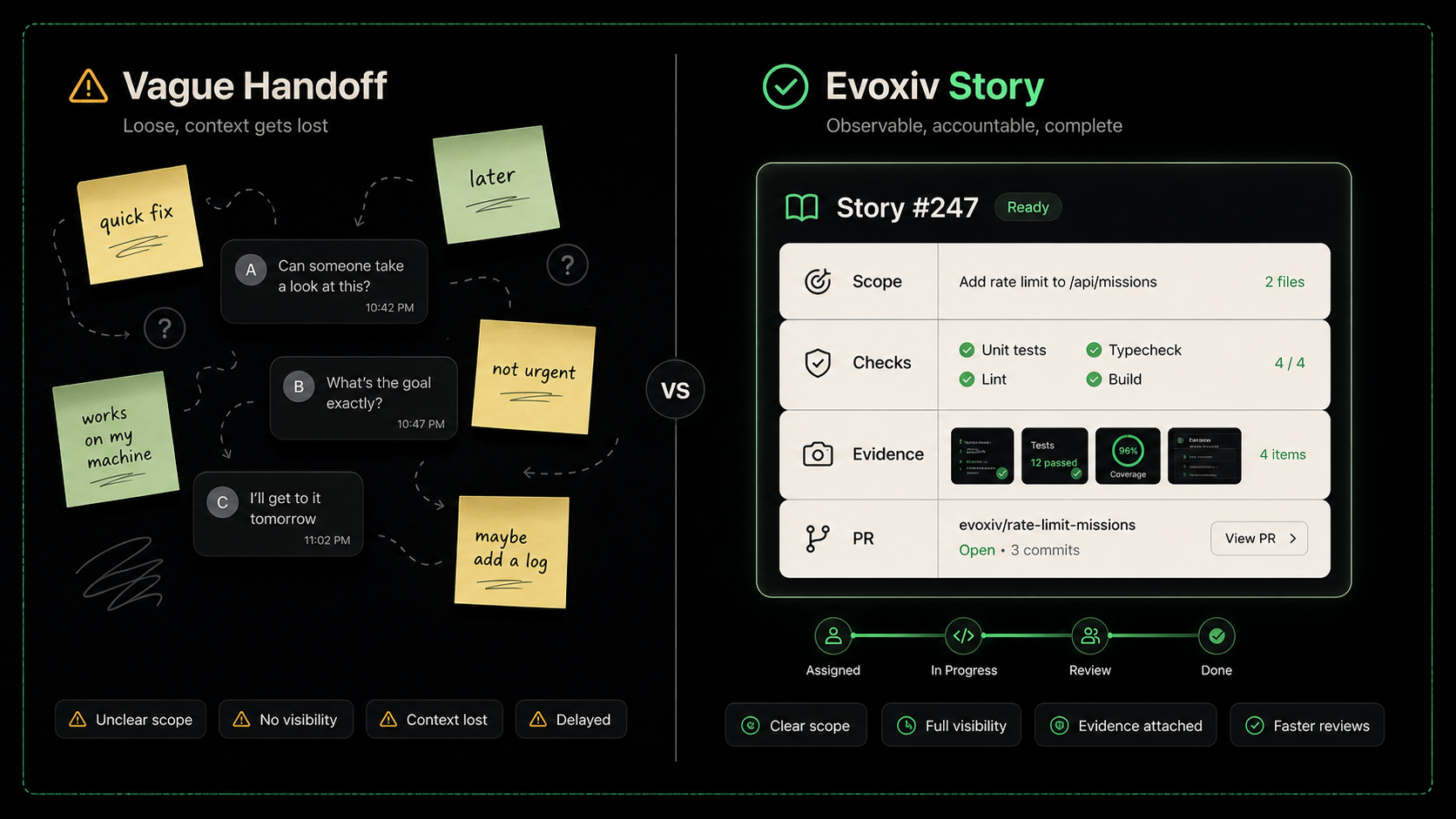
That is the layer evoxiv is built for. A request becomes a Story. The Story carries the intent, the assigned agent, the execution trail, the verification notes, and the pull request link. The team gets an artifact to inspect instead of a pile of status updates to reconstruct.
Why vague handoffs slow down good teams
Vague handoffs punish the people who care most about quality.
The cautious engineer has to ask more questions before touching the code. The reviewer has to infer intent from the diff. The product lead has to remember whether the change was a blocker, a polish item, or a follow-up. The fastest person in the room may still move slowly because the system around the work is under-specified.
This is the everyday gap between "we use AI coding tools" and "we have an AI agent workflow."
An AI coding tool can help a developer produce code faster. An AI agent workflow helps the team move the whole unit of work faster. That includes discovery, implementation, checks, review context, and the final handoff.
For SEO people, this matters because the phrase "developer productivity" often gets flattened into typing speed. But real developer productivity is throughput with quality intact. The valuable metric is not how quickly a patch appears. It is how quickly a team can trust the patch enough to review, merge, and move on.
What an AI agent should carry into review
When an AI software agent finishes a task, the reviewer should not have to ask basic questions. The handoff should already answer them.
A reviewable agent handoff includes:
- The exact scope the agent understood.
- The files and behavior that changed.
- The tests, type checks, builds, or manual checks that ran.
- Any caveats, skipped checks, or known risks.
- A pull request that humans can inspect normally.
This is where teams often set the bar too low. If an agent only produces a diff, the reviewer still has to do project management around it. If the agent produces a diff plus evidence, the reviewer can spend more energy on correctness.
Evoxiv treats that evidence as part of the workflow, not as a nice-to-have. Stories are designed to make the work traceable, so the person reviewing the change can see what happened without reading the agent's mind.
The funny part: "small" is usually a process word
The phrase "small change" does not always mean small code. Sometimes it means:
- Small to explain.
- Small from the user's point of view.
- Small compared with the feature around it.
- Small if you already know the codebase.
- Small if nothing surprising happens.
That last condition is the trap.
A one-line UI change can need copy review, responsive checks, and a screenshot. A simple backend rule can need a migration, fixture updates, and API tests. A quick error message can touch documentation, analytics, and localization later.
An AI agent workflow does not pretend every small request is safe. It gives the request a container so the uncertainty becomes visible early. The Story can say what changed, what was checked, and what still needs human judgment.
That is less flashy than a demo where an agent builds an entire product in one prompt. It is also more useful for real software teams.
A better loop for product teams
The practical loop looks like this:
- Capture the request as a Story.
- Let the agent inspect the repo before changing code.
- Keep the diff narrow.
- Run relevant verification.
- Open a pull request with a clear execution summary.
- Let humans review the result with context.
This loop is boring in the best way. It makes the work repeatable. It gives managers a clear state machine. It gives developers a familiar review surface. It gives AI agents a defined lane instead of an open-ended instruction to "go fix it."
For teams evaluating AI agents for code review, autonomous coding agents, or software delivery automation, this distinction matters. The strongest workflows do not remove accountability. They make accountability easier to see.
Where evoxiv fits
Evoxiv is for teams that want AI agents to participate in real delivery, not just produce impressive snippets.
It turns product requests into trackable Stories, dispatches agents into the right execution context, and preserves the evidence reviewers need: what changed, how it was verified, what caveats remain, and where the pull request lives.
That is how the "one small change" becomes a manageable unit of work instead of an afternoon of thread archaeology.
Small changes will keep arriving. The teams that handle them best will not be the teams with the loudest AI demo. They will be the teams whose workflow makes every change clear enough to ship with confidence.