
AI Agents for Product Operations: Turn Signals Into Shipped Work
Product work rarely arrives as a perfect ticket.
It arrives as a support note, a customer screenshot, a teammate's half-remembered Slack thread, a failed QA check, a product idea from a sales call, and a tiny bug that "should only take a minute." None of those signals are useless. The problem is that they are not yet work.
This is where AI agents for product operations become useful. The best use case is not replacing the product team or skipping engineering review. It is turning scattered product signals into scoped, traceable, reviewable work before they decay into backlog fog.
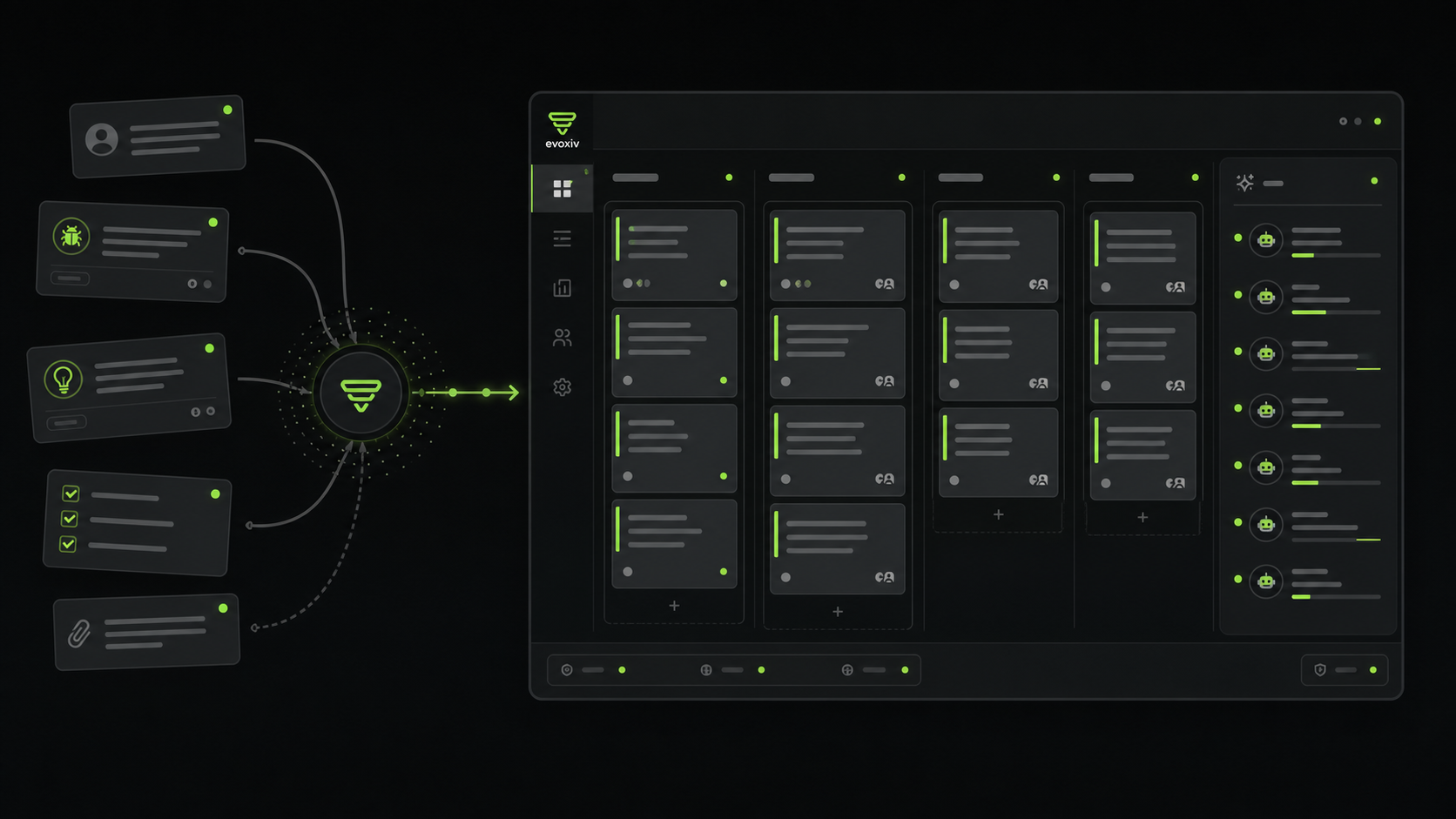
For teams exploring agentic software development, product operations is one of the highest-leverage places to start because the workflow is already full of small handoffs. Evoxiv is built around that reality: capture a request as a Story, dispatch the right agent, produce evidence, open a pull request when code changes, and keep the human review loop intact.
What product operations actually needs
Product operations is the connective tissue between customer feedback, product decisions, engineering execution, and release quality. When it works, teams know what needs attention, why it matters, who owns it, and what proof exists that the work was handled.
When it breaks, the symptoms are familiar:
- Customer feedback gets copied into three tools and loses context.
- Bugs wait for someone to turn a report into reproduction steps.
- Small product fixes sit under larger roadmap work because nobody wants the coordination tax.
- QA findings produce screenshots but not owned follow-up.
- Engineers receive requests without the decision history that made them important.
AI software agents can help because much of this work is structured, repetitive, and evidence-driven. The agent does not need to invent strategy. It needs to preserve context, narrow scope, take the next useful step, and leave a clean trail.
From signal to Story
The first operational win is converting noisy inputs into a Story that a team can actually act on.
A good Story is more than a task title. It should include the user-facing problem, the relevant evidence, the expected outcome, and enough constraints to avoid accidental scope creep. That is exactly the kind of work where an AI agent can save time without pretending to be the final decision-maker.
Instead of asking a human to manually rewrite every customer note, the workflow can look like this:
- A signal arrives from support, QA, sales, design, or internal review.
- Evoxiv captures the signal as a Story with the surrounding context.
- An agent reads the repo, docs, or product surface needed for the task.
- The agent either completes the bounded work or reports why it is blocked.
- Reviewers get the evidence, diff, and execution summary in one place.
The result is not "AI did the product manager's job." The result is that the product manager, engineer, or founder does not have to spend the first half hour reconstructing the task from fragments.
Why this improves SEO and software delivery
Search traffic rewards clear answers to real operational problems. Teams are not only searching for "AI coding agent." They are searching for ways to reduce backlog drift, improve developer productivity, automate software delivery, and keep customer feedback connected to engineering work.
That broader search intent matters. A team looking for AI agents for product operations may not be ready to automate code changes immediately. They may be asking a more basic question: how do we stop losing product intent between feedback and implementation?
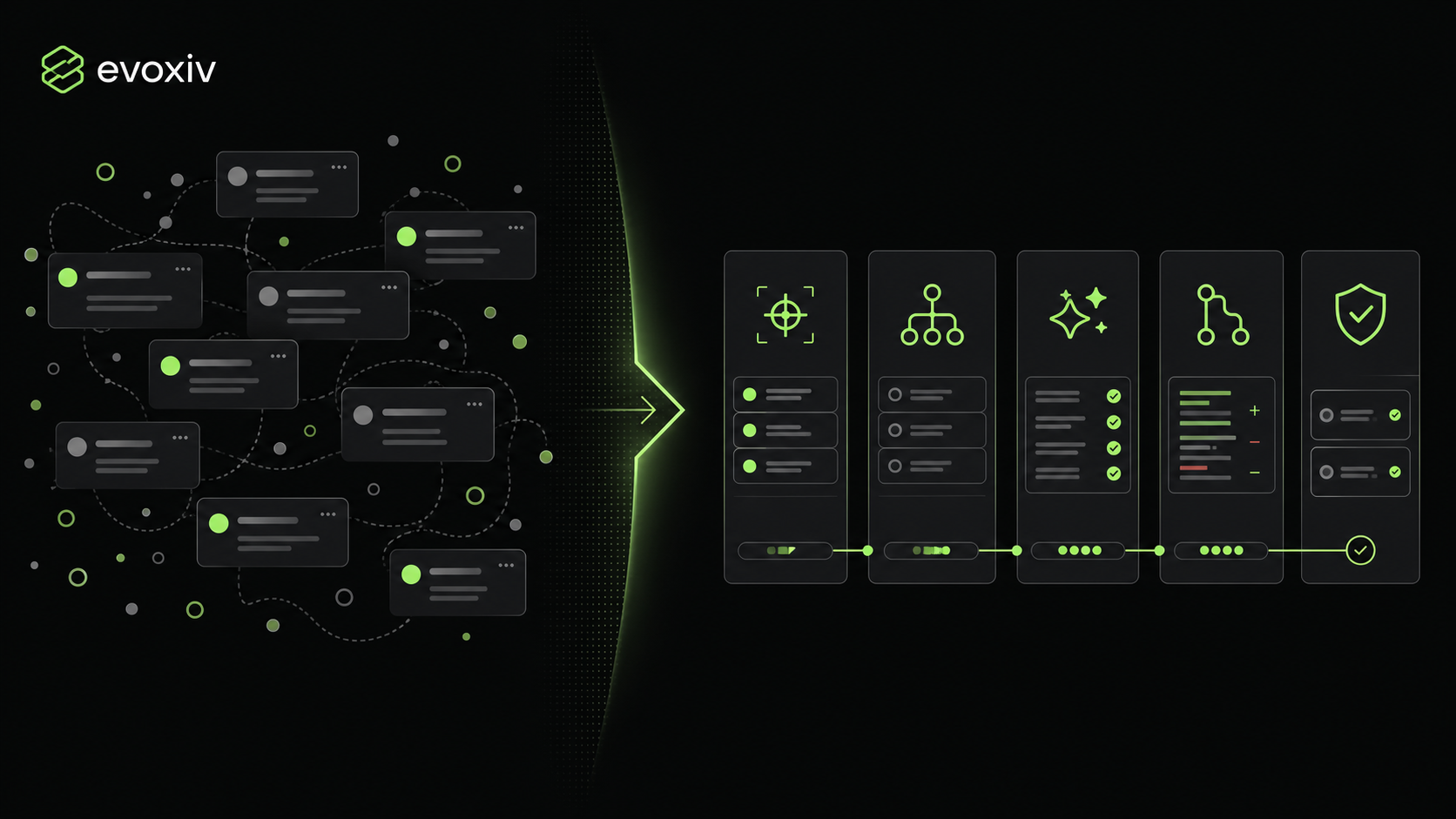
Evoxiv answers that question by treating every agent run as part of an accountable workflow. Stories are scoped. Agents are assigned. Outputs are reviewable. Pull requests are linked back to the request that caused them. That is the difference between a chat transcript and an operating system for software work.
The compounding value of small work
Most teams underestimate the amount of product quality hidden in small work.
One unclear button label does not justify a planning meeting. One stale onboarding screenshot does not need a full sprint ceremony. One missing empty state is not a roadmap initiative. But dozens of those small misses shape how a product feels, how much support it needs, and how much trust users place in it.
The traditional options are weak:
- Let the work sit until it is painful enough to prioritize.
- Interrupt an engineer every time a small issue appears.
- Batch everything into a cleanup sprint that keeps getting postponed.
- Ask a general-purpose assistant to help, then manually stitch the output back into your workflow.
AI agents for product operations offer a better pattern. Use agents for the bounded, reviewable middle layer: triage the signal, inspect the relevant context, make the smallest defensible change when code is needed, run checks, and produce a reviewable artifact.
Humans still decide what matters. Humans still review the change. The agent removes the drag between "we noticed this" and "there is a concrete thing to approve."
What to automate first
The safest starting points are workflows with clear evidence and low ambiguity.
Try these before asking agents to build large new features:
- Turn customer feedback into de-duplicated product Stories.
- Convert QA screenshots into reproducible tasks with acceptance criteria.
- Sweep stale small fixes and prepare reviewable pull requests.
- Check critical flows on a schedule and file follow-up work when they break.
- Preserve implementation context so reviewers understand why a change exists.
These are not glamorous tasks, which is exactly why they are good candidates. They are frequent, easy to verify, and expensive mostly because of coordination rather than deep invention.
A practical operating model
The useful model for AI agents in software teams is not autonomy without accountability. It is autonomy with receipts.
For product operations, that means every agent action should answer a few simple questions:
- What signal caused this work?
- What context did the agent inspect?
- What changed?
- How was it verified?
- What should a human review next?
If an agent cannot answer those questions, it is not improving product operations. It is creating another artifact someone has to manage.
Evoxiv is designed around the reviewable version of agentic work. A Story gives the agent scope. The run captures execution. The pull request gives engineering a normal review surface. The Story body keeps the operational context attached to the outcome.
The point is not more automation. It is less leakage.
Product teams do not need another place for requests to disappear. They need a way to keep product intent connected to execution.
That is the real promise of AI agents for product operations: fewer dropped signals, fewer vague handoffs, fewer small fixes left to drift, and more reviewable work moving through the system.
For teams evaluating Evoxiv, start with the work that already has context, evidence, and a clear finish line. Let agents carry the coordination load. Keep humans on judgment, prioritization, and review.
That is how scattered product signals become shipped software instead of another tab waiting for someone to remember why it mattered.