
AI Agents for Engineering Context: Stop Losing the Thread
The hidden cost of software work is not only the time spent writing code. It is the time spent remembering why the code needed to change in the first place.
A customer report starts in a support thread. The design note lives in a separate tab. The reproduction steps are in a video. The product intent is in someone's head. The last failed attempt is buried in a stale branch. By the time an engineer is ready to fix the issue, the real job is not implementation. It is excavation.
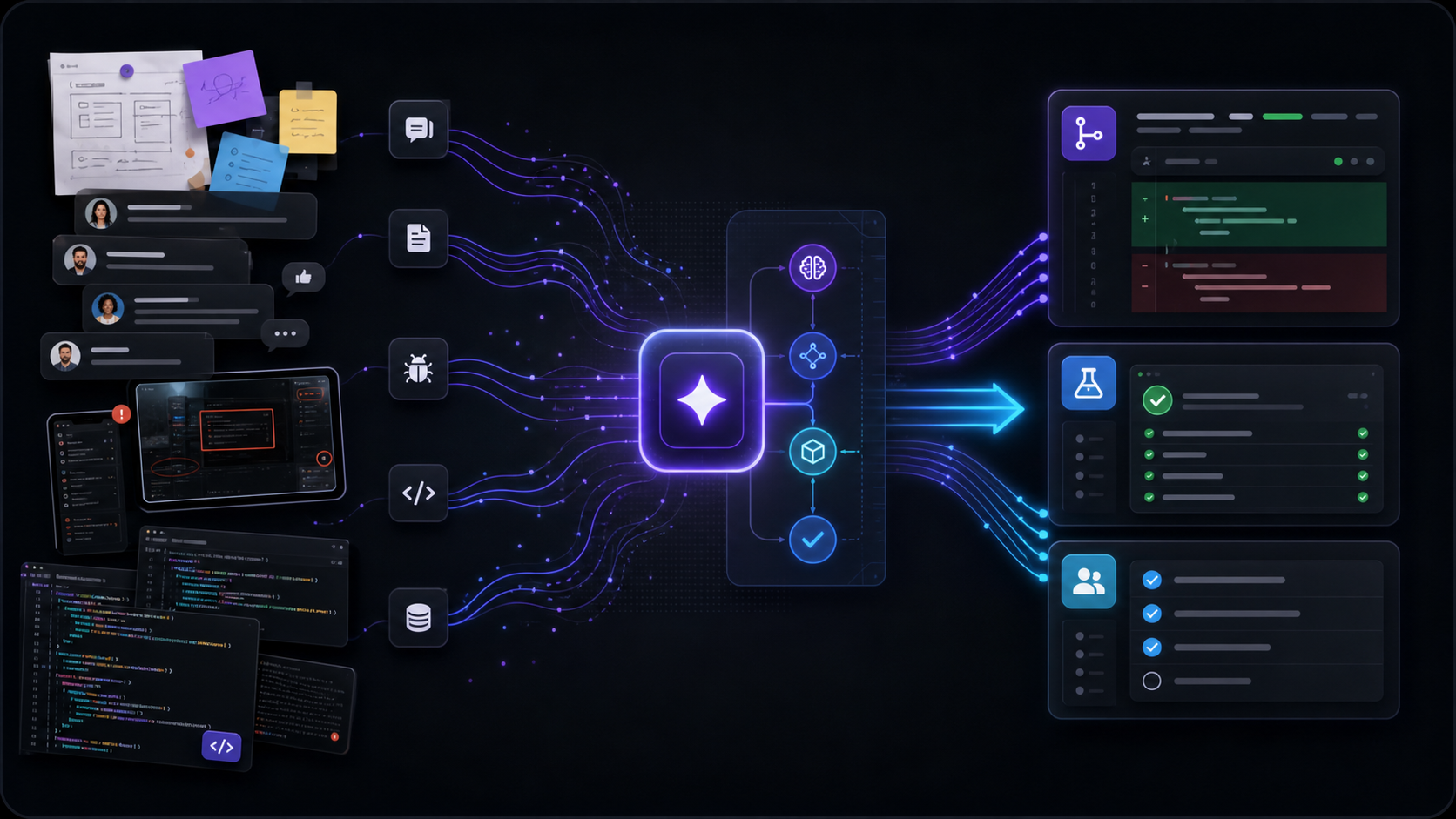
That is why engineering context is becoming one of the most important places to apply AI agents. Not as a replacement for senior judgment. Not as a vague assistant that generates code from thin air. The practical value is more operational: an AI agent can collect the request, keep the surrounding evidence attached, turn it into a scoped Story, make the smallest defensible change, and leave a reviewer with the context needed to decide.
For software teams evaluating agentic software development, this is a better starting point than asking whether agents can "build features." A more useful question is: can they stop the team from losing the thread?
Why engineering context disappears
Software teams do not usually lose context because people are careless. They lose it because modern product work is fragmented by default.
The work crosses tools: issue trackers, pull requests, chat, dashboards, customer notes, design files, test output, and deployment logs. It crosses time zones. It crosses roles. It also crosses levels of detail. A product manager cares about the user outcome. A designer cares about the interaction. An engineer cares about the edge case. A reviewer cares about whether the patch is safe.
All of those perspectives matter, but they rarely arrive in one tidy packet.
The result is a familiar pattern. A small request waits because nobody has the full picture. A bug gets reassigned because the first owner cannot reconstruct the reproduction. A pull request takes longer to review because the reviewer has to ask, "What problem is this solving?" A useful fix stalls not because the change is hard, but because the context is scattered.
This is expensive for any team. It is especially expensive for fast-moving startups, distributed engineering teams, and product organizations that depend on short feedback loops.
What AI agents can preserve
An AI agent workflow is useful when it treats context as part of the deliverable.
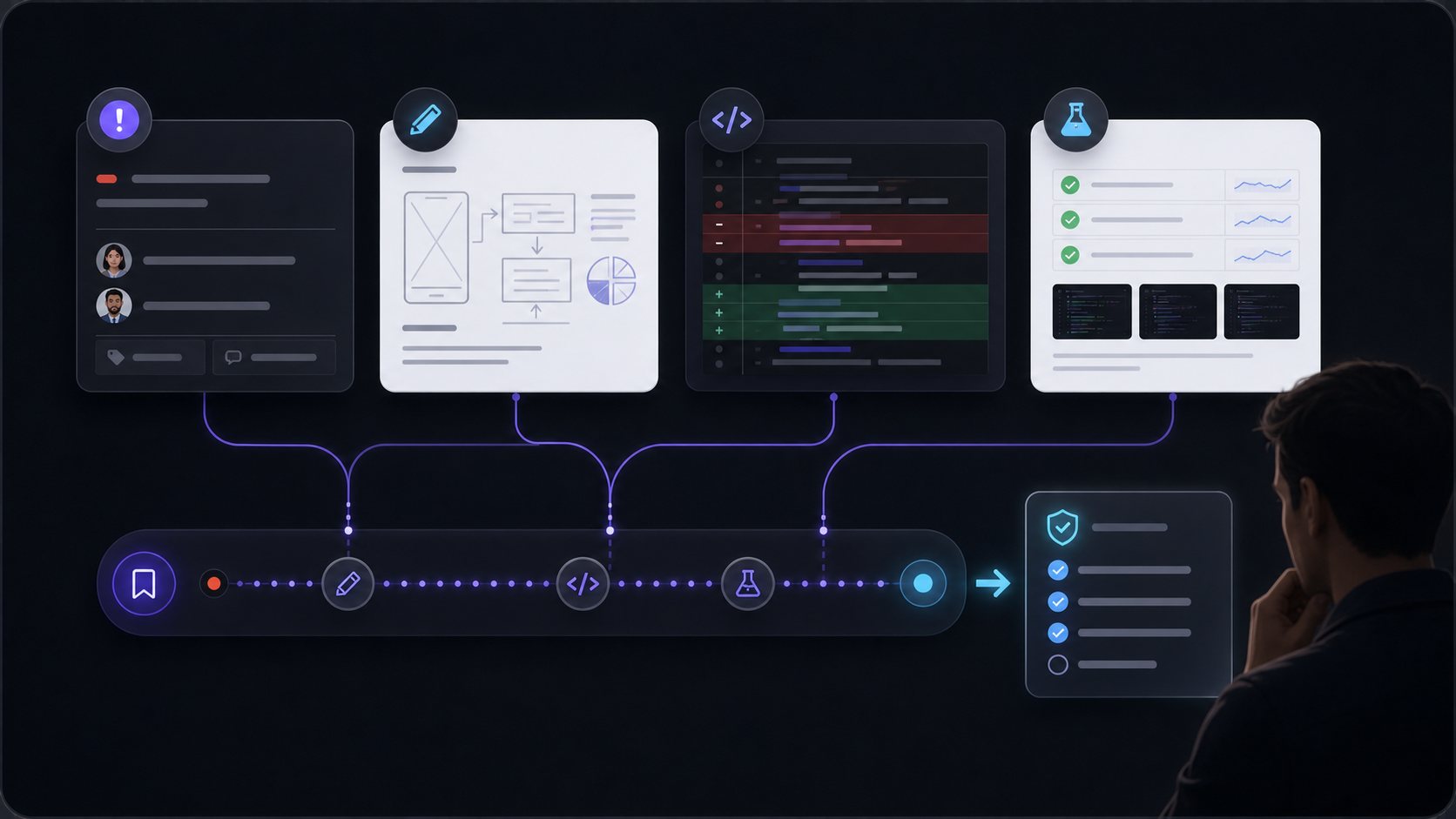
That means the agent should not only produce a patch. It should preserve the chain from intent to implementation:
- What request triggered the work
- What files, flows, or user states were relevant
- What assumptions shaped the change
- What tests or checks were run
- What evidence a reviewer should inspect
- What follow-up was intentionally left out of scope
This is the difference between "AI generated a diff" and "AI delivered a reviewable unit of work." The first creates more burden for a human reviewer. The second reduces the reviewer's search cost.
Evoxiv is designed around that second model. Work starts as a Story, which gives the agent a concrete scope. The agent reads the repository, makes a focused change, verifies it, opens a pull request when there is code to review, and records an execution summary. The reviewer is not asked to trust magic. They are handed a trail.
The context handoff problem
The hardest handoffs are not always between people. They are often between moments.
Monday's bug report becomes Wednesday's fix. A late-night idea becomes tomorrow's sprint task. A failing QA flow becomes a follow-up Story. A product request gets clarified after the engineer who first read it has moved on to something else.
Every delay creates a chance for meaning to decay. The original urgency fades. The exact reproduction gets simplified. The "obvious" constraint becomes invisible. The next person sees the task but not the reasoning around it.
AI agents for software teams can help because they are good at keeping the work packet intact. They can carry the prompt, repository findings, implementation notes, verification output, and reviewer caveats together. That makes the next human interaction more efficient.
The goal is not to remove humans from the loop. The goal is to make the loop less wasteful.
A practical agentic workflow for context-heavy work
A strong AI agent workflow for engineering context usually follows five steps.
First, the request becomes a scoped Story. This matters because vague work produces vague output. "Improve onboarding" is too broad. "Fix the mobile clipping on the invite step and verify the flow at narrow width" is much better.
Second, the agent reads before changing. It should inspect the relevant code, nearby patterns, tests, and product surface before deciding what to edit. This is where many lightweight coding assistants fall short: they jump to generation before understanding the local system.
Third, the agent makes a narrow change. Context preservation works best when the implementation surface is small enough for a reviewer to reason about. A focused pull request is easier to verify, easier to revert, and easier to learn from.
Fourth, the agent runs checks and captures evidence. Tests, type checks, lint, screenshots, API responses, and command output all help turn a claim into something reviewable.
Fifth, the agent summarizes the decision path. The reviewer should be able to see what changed, why it changed, how it was verified, and what caveats remain without reconstructing the entire run.
That final summary is not ceremony. It is how the context survives the handoff.
Where this helps most
Context-preserving AI agents are especially useful in work that is important but easy to interrupt:
- Customer-reported bugs that need reproduction and a focused fix
- Small product improvements that cross frontend, backend, and copy
- QA follow-ups where screenshots or browser evidence matter
- Maintenance tasks with subtle local conventions
- Review preparation for pull requests that need a clear audit trail
- Recurring operational checks that should become work only when something breaks
These are not glamorous examples, which is exactly why they matter. A large share of product velocity is won or lost in ordinary work. The team that handles ordinary work cleanly has more time and trust for the ambitious work.
What to look for in AI agents for software teams
If you are comparing AI software agents, look past demo speed. Speed is useful, but only when the output is reviewable.
The stronger questions are:
- Does the agent preserve the original request?
- Does it explain what it inspected before editing?
- Does it keep the diff focused?
- Does it run the checks that matter for the repository?
- Does it produce a pull request instead of an untraceable patch?
- Does it leave caveats where a human reviewer needs judgment?
Those behaviors are what make agentic software development useful inside real teams. They turn AI from a one-off code generator into an operational teammate that can carry work across time, tools, and reviewers.
The real benefit: fewer cold starts
Engineering teams often talk about developer productivity as if the main problem is typing speed. But many of the worst delays are cold starts.
Cold starts happen when someone has to reload a problem from scratch. They read the ticket, open the repo, search for related code, ask for missing context, rerun a failing path, and build enough confidence to act. Some of that work is necessary. Too much of it is repeated.
AI agents help when they reduce those cold starts. They keep the work warm. They move a request from scattered context to a concrete artifact. They let a reviewer start from evidence instead of archaeology.
That is a practical reason to adopt AI agents in software development: not because every line of code should be automated, but because the thread of the work should not keep breaking.
Evoxiv gives teams a way to turn that thread into Stories, verified changes, pull requests, and review summaries. The human still decides what matters. The agent makes sure the context arrives with the work.