
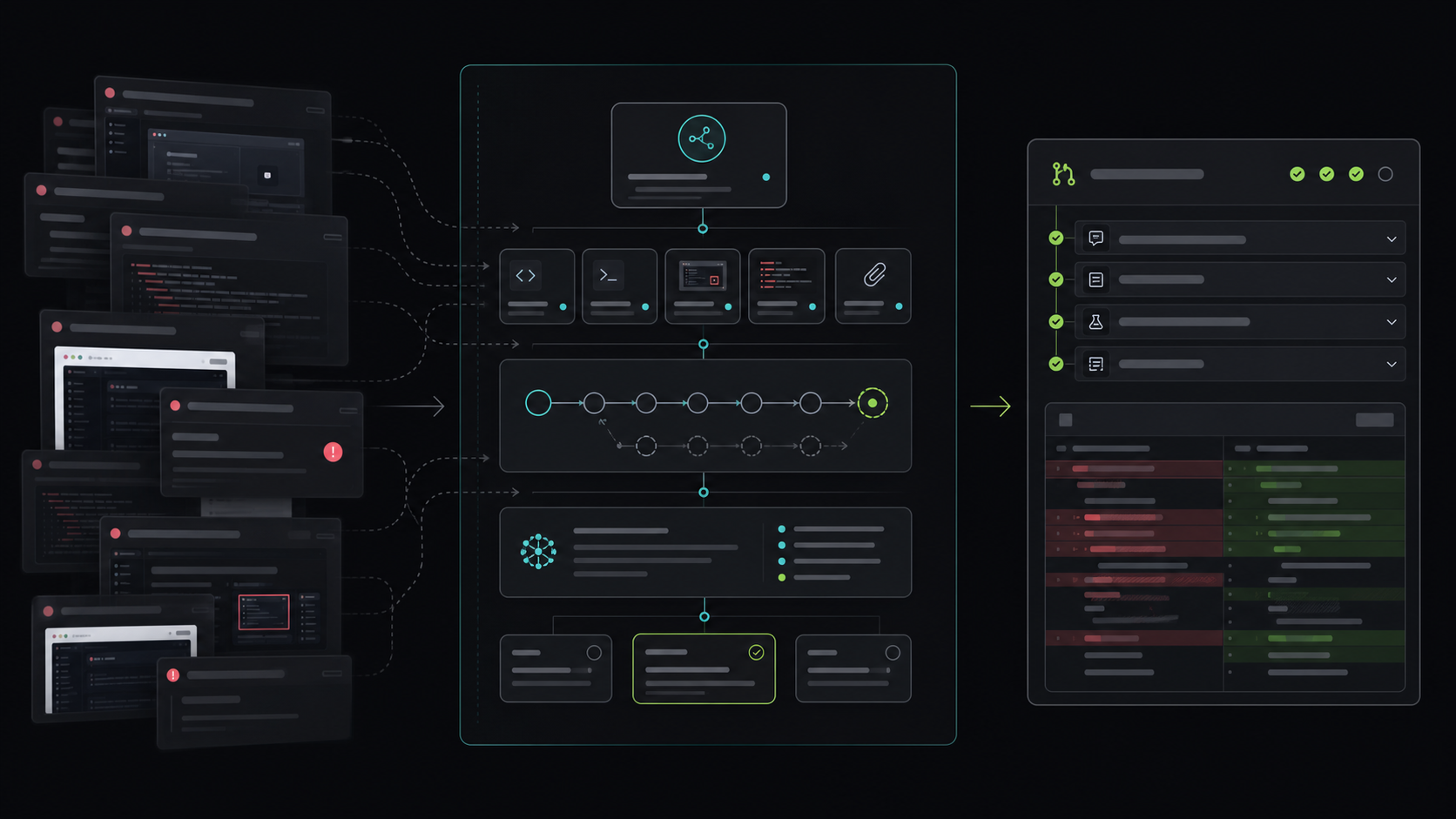
AI Agents for Bug Triage: Turn Reports Into Reviewable Fixes
Bug triage is one of the least glamorous parts of software delivery, which is exactly why it eats so much time.
A customer says checkout froze. A teammate drops a screenshot into chat. A QA run fails once and passes twice. The browser console has a red line, but nobody knows whether it is the cause or just noise. Before anyone can fix the bug, someone has to turn that pile of evidence into a clear answer: what happened, how to reproduce it, where it likely lives, and what a safe fix would look like.
That is the real value of AI agents for bug triage. The agent is not there to wave away engineering judgment. It is there to do the connective work between a vague report and a reviewable pull request.
For teams evaluating AI agents for software teams, bug triage is a practical starting point because the workflow has clear inputs and clear outputs. The input is messy evidence. The output is a scoped Story, a reproducible path, a focused fix when the code path is clear, and verification evidence a human can review.
Why bug triage slows teams down
Most bugs are not hard because the final patch is large. They are hard because the team has to reconstruct the situation around the bug.
Good triage asks several questions before implementation starts:
- What did the user expect to happen?
- What actually happened?
- Which browser, account state, role, plan, feature flag, or integration was involved?
- Is there a screenshot, log line, network request, or failing test?
- Can the issue be reproduced consistently?
- Is this a product decision, a frontend bug, a backend bug, or an integration failure?
When those answers are missing, engineering time turns into archaeology. The bug bounces between people. The report gets rewritten. The fix waits because nobody wants to interrupt their current work just to rebuild the context.
AI bug triage helps by shortening that cold start. A well-scoped agent can read the report, inspect the relevant product surface or repository area, collect the evidence, and either produce a narrow fix or explain exactly what is still missing.
What AI bug triage should actually do
Useful bug triage automation is not a chatbot saying, "try clearing your cache." It is an operational workflow that converts uncertainty into reviewable evidence.
An AI agent for bug triage should be able to:
- Extract the symptom from the original report.
- Identify likely affected surfaces.
- Look for related code, tests, routes, logs, or recent changes.
- Build a reproduction path or name what blocks reproduction.
- Create a scoped Story with acceptance criteria.
- Make a minimal code change when the cause is clear.
- Run the relevant checks.
- Attach an execution summary for review.
That sequence matters because it keeps humans in the right place. Humans decide priority, customer impact, product behavior, and merge risk. The agent handles the structured work that usually delays that decision.
From bug report to reproducible Story
The first artifact should be a Story, not a patch.
A Story gives the bug a stable home. It keeps the original symptom, evidence, constraints, and expected outcome attached to the work. Without that, the team ends up with a branch or chat thread that explains what changed but not why it changed.
A good bug Story usually includes:
- The user-facing symptom in plain language.
- The expected behavior and actual behavior.
- The reproduction steps, or the best current hypothesis if reproduction is incomplete.
- Relevant screenshots, logs, traces, URLs, or environment notes.
- The smallest acceptable fix.
- Verification steps the agent or reviewer should run.
In Evoxiv, that Story becomes the unit of agent work. The agent reads the relevant context, operates inside the requested scope, and reports back with either a reviewable change or a clear blocker. That makes bug triage less dependent on whoever happened to see the first report.
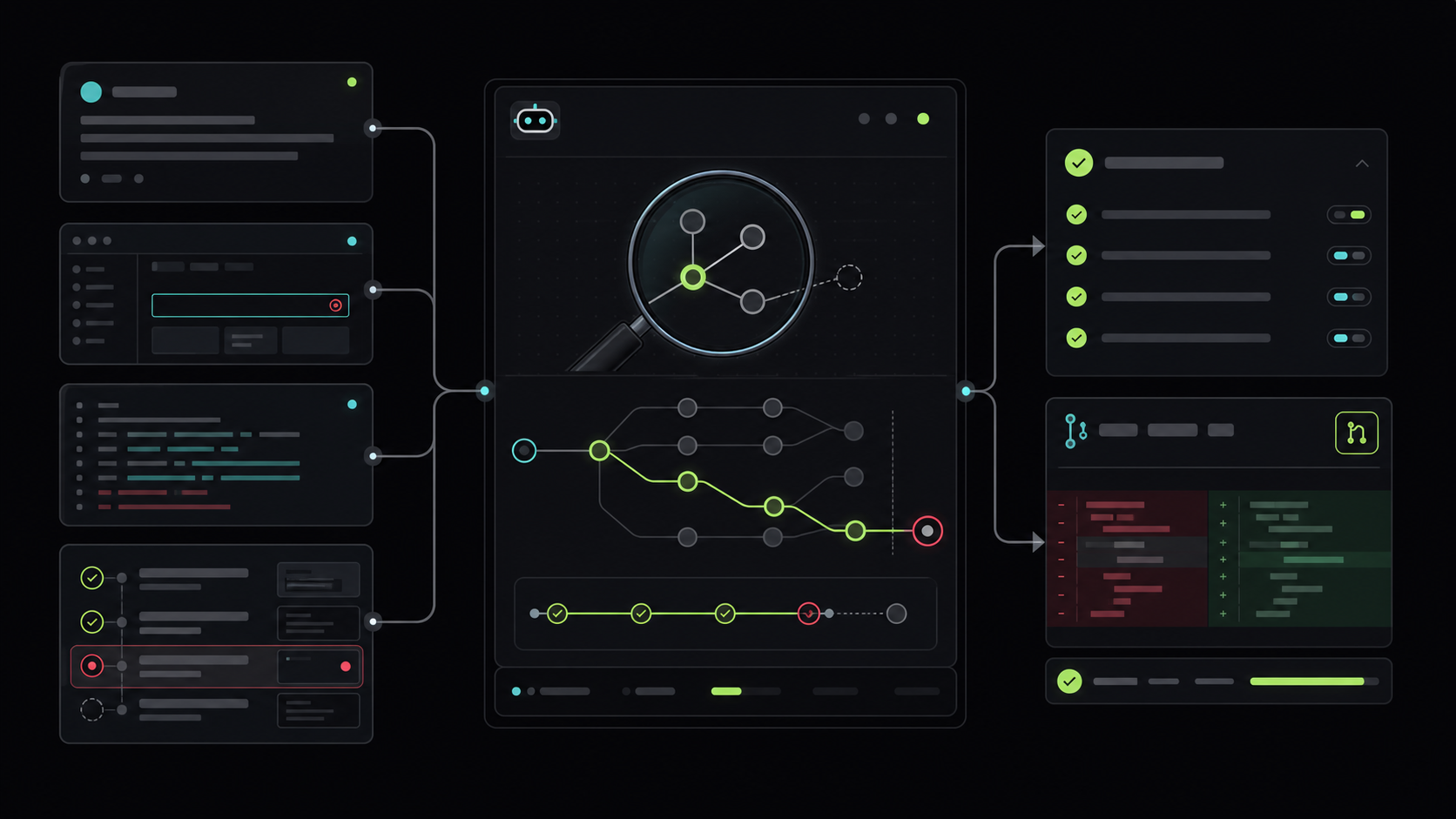
The evidence packet that makes a fix reviewable
Bug fixes fail review when the reviewer cannot tell whether the fix matches the bug.
The diff may be small. The code may look reasonable. But if the reviewer cannot see the reproduction path, the failing behavior, and the verification result, they are still guessing.
An AI agent should leave an evidence packet behind every bug fix:
- Original report: the prompt or source signal that caused the work.
- Reproduction: steps taken, states tested, and whether the issue reproduced.
- Diagnosis: the code path or product path the agent inspected.
- Change: the smallest behavior change made.
- Verification: exact commands, screenshots, API responses, or manual checks.
- Caveats: what was not verified and what should be watched next.
This evidence turns AI coding agents from a source of mystery into a normal engineering workflow. A reviewer can compare the Story to the diff, inspect the checks, and decide whether the change should ship.
Where agents save the most time
AI agents for bug triage are most useful when the task is bounded and evidence-heavy.
Strong candidates include:
- Customer-reported UI bugs with screenshots or browser details.
- Broken onboarding, signup, billing, or settings flows.
- Regressions that likely came from a recent focused change.
- Small API behavior mismatches with clear request and response examples.
- Copy, empty state, validation, and permission bugs.
- Flaky or failing tests that need a first-pass diagnosis.
These bugs are expensive because of coordination, not because each one needs a week of design. The agent can gather context, inspect the codebase, run checks, and prepare a fix while the human team stays focused on judgment and prioritization.
There are also cases where the agent should stop early. If the bug depends on missing production data, private customer details, unclear product policy, or a security-sensitive decision, the right output is not a guessed patch. The right output is a Story update that says what is missing and what would unblock the next step.
A practical workflow for AI-assisted bug triage
A strong AI bug triage workflow can be simple.
- Capture the bug signal as a Story.
- Ask the agent to identify the affected surface and inspect the local code.
- Require reproduction notes or a clear reason reproduction is blocked.
- Limit the agent to the smallest defensible change.
- Run tests, lint, type checks, browser checks, or API probes that match the bug.
- Open a pull request when code changed.
- Keep the execution summary attached to the Story.
This workflow is faster than ad hoc assignment because the agent does not need a meeting to start. It is safer than blind code generation because every step leaves review evidence.
The key is not to ask the agent to "fix all bugs." That is too broad. Ask for one bounded bug, one reproduction path, one focused change, and one reviewable result.
What to look for in an AI bug triage platform
If you are comparing AI software agents for bug triage, look beyond whether the demo produces code.
The better questions are operational:
- Can the agent preserve the original report?
- Can it inspect the repository before editing?
- Can it create or update a scoped Story?
- Can it attach screenshots, image evidence, logs, or command output?
- Can it open a normal pull request instead of handing you a loose patch?
- Can a reviewer see what was verified?
- Can the agent stop cleanly when product judgment is required?
Those capabilities matter because bug triage is a trust problem. The team needs enough evidence to decide whether the agent reduced risk or merely moved the uncertainty somewhere else.
Evoxiv is built for the reviewable version of agentic software development. Work is captured as Stories. Agents run against the repository and task context. Code changes move through pull requests. Execution summaries tell reviewers what changed, how it was verified, and what caveats remain.
The SEO value is the operational value
Searches for "AI bug triage," "bug triage automation," and "AI coding agents" all point to the same underlying need: teams want fewer vague reports sitting between users and fixes.
The winning workflow is not a bigger backlog. It is a cleaner path from report to reproduction, from reproduction to fix, and from fix to review.
That is where AI agents are useful. They reduce the handoff tax around ordinary bugs. They keep the evidence attached. They produce reviewable software work instead of isolated suggestions.
For teams adopting Evoxiv, bug triage is a strong first workflow because it is concrete, frequent, and easy to judge. Start with the bugs that already have evidence. Let the agent turn that evidence into a scoped Story, a focused pull request, and a clear verification trail.
The result is not magic. It is better operations: fewer dropped reports, fewer cold starts, and more fixes arriving in a form your team can actually review.