
AI Agents for Asynchronous Software Work: Wake Up to Reviewable PRs
The most expensive software work is not always the coding. Often it is the waiting.
A product manager leaves a request at the end of the day. An engineer sees it after dinner but needs more context. A bug report arrives with a screenshot and no owner. A failing check sits in CI until the next standup. By the time the team gets back together, everyone spends the first hour reconstructing what the work even was.
That delay is normal in distributed teams, but it is not free. Every handoff creates a small tax: restating intent, finding the right repository, checking whether the work is already tracked, deciding who owns it, and proving the change is safe. The code may only take thirty minutes. The coordination can eat the morning.
AI agents for asynchronous software work are useful because they can move the first half of that workflow forward while humans are away. Not by merging unreviewed code in the dark. Not by pretending software delivery is fully automatic. The useful version is more practical: an agent turns a clear request into a scoped Story, makes the smallest defensible change, runs checks, opens a pull request, and leaves the evidence ready for review.
That is the difference between waking up to another discussion and waking up to a reviewable artifact.
Why asynchronous work breaks down
Asynchronous software teams already know how to write messages, tickets, and specs. The breakdown usually happens after the message is sent.
A request that feels obvious to the sender may be ambiguous to the person implementing it. A small bug may span frontend, backend, and deployment config. A quick copy change may need screenshots. A dependency update may require test evidence before anyone trusts it. Because the work is not fully shaped, teams defer it until a synchronous conversation can happen.
That pattern is reasonable, but it creates a hidden backlog of almost-ready work. The team is not blocked by talent. It is blocked by activation energy.
Asynchronous AI agents reduce that activation energy when the work has enough context to start. They can read the request, inspect the repo, identify the relevant files, create a branch, implement a narrow change, and report exactly what happened. The human reviewer still decides whether the work ships, but the reviewer starts from evidence instead of a blank page.
The useful unit is a Story, not a chat thread
A chat message is a poor container for software work. It is easy to send and easy to lose. It usually does not carry status, ownership, verification, or review state.
A Story is a better unit. It has a goal, an owner, a lifecycle, and a visible outcome. In an agentic software development workflow, the Story becomes the contract between the human and the agent: here is the request, here is the repository, here are the acceptance criteria, and here is what must be returned before review.
That structure matters more for asynchronous work than for synchronous work. When nobody is online to clarify every step, the system needs to preserve context. The agent should not simply say, "done." It should attach the branch, the pull request, the tests it ran, the caveats it found, and any follow-up that belongs outside the current scope.
This is where many AI coding tools feel impressive in a demo but fragile in production. They generate code, but they do not always generate a reliable operational trail. For async teams, the trail is the product.
What a good overnight agent run looks like
A good asynchronous agent run is boring in the right ways.
It starts with a bounded request: adjust a pricing page, fix a flaky test, add a small API guard, update a help page, investigate a broken flow, refresh a recurring report, or turn a known bug into a patch. The agent reads the repo before editing. It follows the local style. It keeps the diff small. It runs relevant checks. If it cannot finish safely, it explains why instead of forcing a change.
The next morning, the team should see a pull request with a clear summary and verification notes. The reviewer should not need to ask which files changed, whether tests ran, or why the agent chose that approach. Those details should already be there.
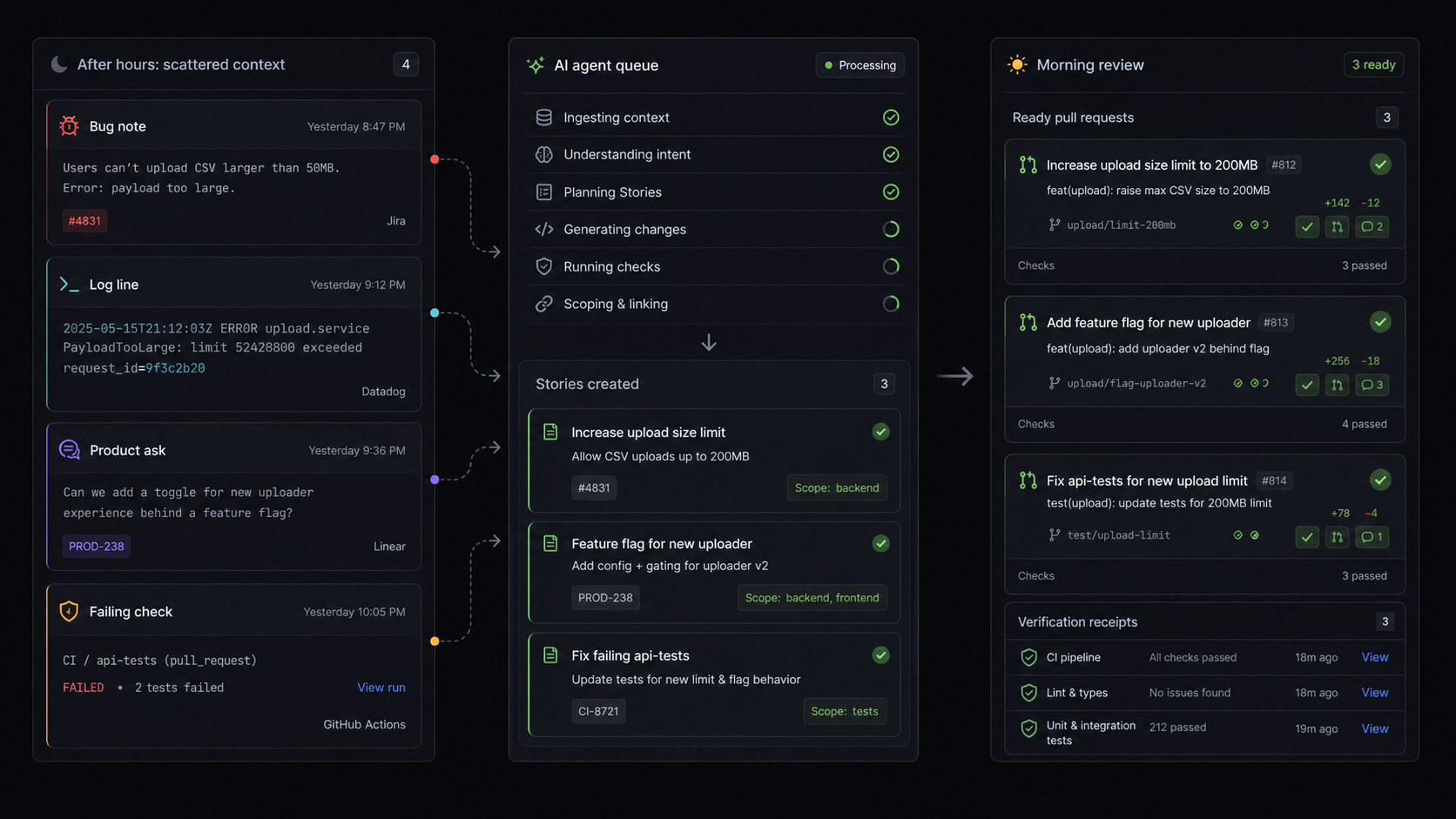
That is the practical SEO phrase behind the workflow: AI agents for software teams should turn asynchronous context into reviewable pull requests. The value is not only speed. It is continuity.
Where async AI agents save the most time
The best starting points are tasks with clear boundaries and visible verification.
One strong category is small product polish: copy fixes, layout issues, empty states, settings labels, documentation updates, and minor UI behavior changes. These tasks are real, but they often wait because they are too small to interrupt a developer mid-feature.
Another category is recurring maintenance. Dependency checks, stale TODO cleanup, test updates, and routine compatibility fixes are perfect examples of work that benefits from a steady agent rhythm. The team still reviews the pull request, but the discovery and first pass no longer depend on someone remembering to do it manually.
A third category is investigation. An agent can reproduce a bug, collect logs, inspect likely files, and open a Story with evidence even when it does not make a code change. That is still valuable asynchronous work because it gives the next human or agent a sharper starting point.
The common thread is that the agent produces something reviewable. If the output cannot be inspected, tested, or accepted, it is not a good async automation target.
What should stay human
Asynchronous AI agents should not become a way to avoid product judgment. Roadmap tradeoffs, customer positioning, architecture direction, pricing strategy, and risky migrations still deserve human attention.
The better model is delegation with review. Humans decide what matters. Agents move well-scoped work through the mechanical parts of delivery. Reviewers inspect the output before it ships.
That balance keeps the workflow trustworthy. It also prevents the team from treating AI as a mysterious parallel developer. In a healthy agentic workflow, agents are visible contributors with constrained authority and documented results.
How Evoxiv supports asynchronous delivery
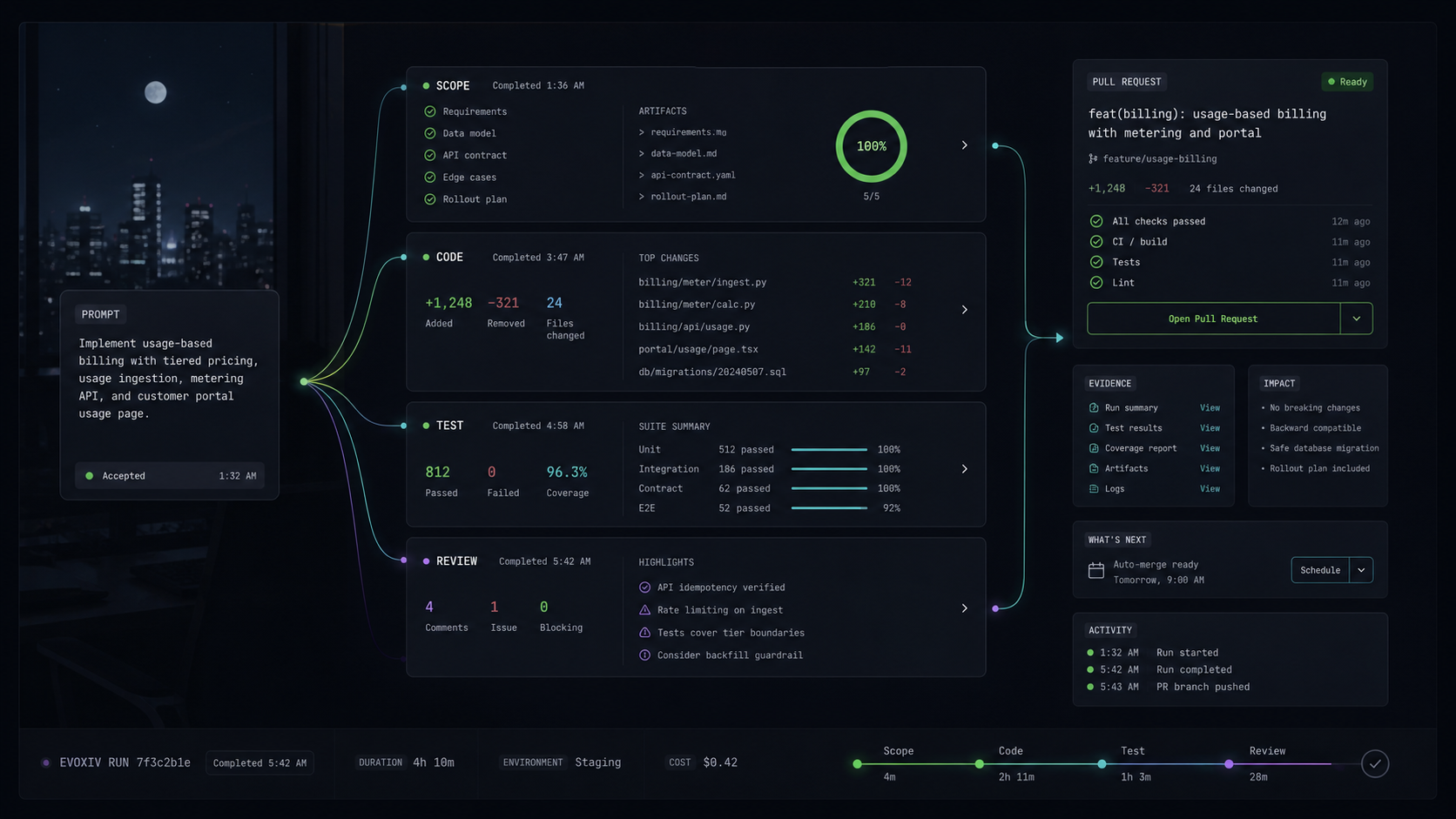
Evoxiv is built around the idea that AI software agents need a production workflow around them. A request becomes a Story. A Story is assigned to an agent. The agent works in the repository, opens a pull request when there is a code change, and appends an execution summary that explains what changed and how it was verified.
That makes asynchronous work easier to trust. The team does not need to search through a chat transcript to understand what happened overnight. The work is attached to the same artifacts engineers already use: branches, commits, pull requests, checks, and review notes.
For growing teams, this can change the shape of the day. Instead of spending the morning sorting yesterday's loose ends, engineers can start with reviewable work. Some pull requests merge. Some need changes. Some become follow-up Stories. But the conversation begins from a concrete artifact.
That is the real promise of AI agents for asynchronous software work: fewer cold starts, tighter handoffs, and more mornings where the next useful step is already visible.