
Agentic Code Review Checklist: How to Trust AI Coding Agents
AI coding agents are useful only when their work can survive review.
That sounds obvious, but it is where many teams get stuck. The demo is exciting: a request goes in, a diff comes out, and the agent explains what it did. Then the real engineering questions begin. Did it understand the scope? Did it touch the right files? Did it run the right checks? Can a reviewer tell the difference between a safe change and a confident guess?
An agentic code review checklist turns that uncertainty into a repeatable workflow. The goal is not to slow AI-assisted development down. The goal is to make AI coding agents easier to trust because every run leaves evidence a human can inspect.
Evoxiv is built around that reviewable model. Work starts as a Story, agents operate inside that scope, and code changes move through normal pull request review with an execution summary attached. The checklist below is a practical way to evaluate any AI agent run before it reaches production.
Why AI coding agents need a review checklist
Traditional code review assumes the author can answer questions, remember intent, and explain tradeoffs. AI agents can explain their work, but that explanation is not enough by itself. Reviewers need durable proof: the original request, the files inspected, the diff, the verification steps, and the caveats.
Without a checklist, teams fall into two bad patterns:
- They over-trust the agent because the result looks polished.
- They under-use the agent because every output feels like a mystery.
Both waste the same opportunity. AI coding agents should handle bounded software work while making the human review loop clearer, not fuzzier.
The strongest agentic workflows make the review surface explicit. A reviewer should be able to answer five questions quickly:
- What problem was the agent asked to solve?
- What scope did it choose?
- What changed in the codebase?
- How was the change verified?
- What risk remains?
If those answers are scattered across a chat thread, terminal output, and a branch name, the team is still doing manual reconstruction. A better workflow keeps the answers attached to the work.
1. Start with a scoped Story
The first review artifact is not the pull request. It is the Story that caused the work.
A good Story gives the agent a bounded target: the user-facing problem, the expected outcome, relevant constraints, and any acceptance criteria. It should be clear enough that a reviewer can later ask, "Did this diff actually solve that request?"
For AI software agents, this matters more than it does for humans. A human teammate can infer product context from months of shared work. An agent needs the context stated or discoverable. If the Story is vague, the agent may still produce code, but the reviewer has to decide whether the code belongs.
Use this Story checklist before dispatching an agent:
- The problem is stated in user or product terms.
- The desired outcome is concrete.
- The scope is small enough for one review.
- Important constraints are written down.
- The agent is allowed to stop and report a blocker instead of inventing around missing context.
This is how agentic software development avoids becoming an open-ended prompt. The Story is the contract. The pull request is the implementation.
2. Review the diff for intent, not just syntax
AI generated code can pass a quick syntax scan and still miss the product intent. The reviewer should inspect the diff against the Story, not against the agent's confidence.
Look for three signals:
- The changed files are the files you would expect for the task.
- The implementation matches existing local patterns.
- The diff is narrower than the agent's explanation.
That last point matters. A good AI coding agent should avoid unrelated cleanup. Broad refactors make it harder to know which behavior changed and why. If the Story asked for a small fix, the review should not include a style overhaul, dependency churn, and renamed components unless those are required.
In Evoxiv, this boundary is intentional. The agent is expected to read first, match the codebase, keep the blast radius tight, and produce a pull request that a teammate can review like normal engineering work.
3. Require verification evidence
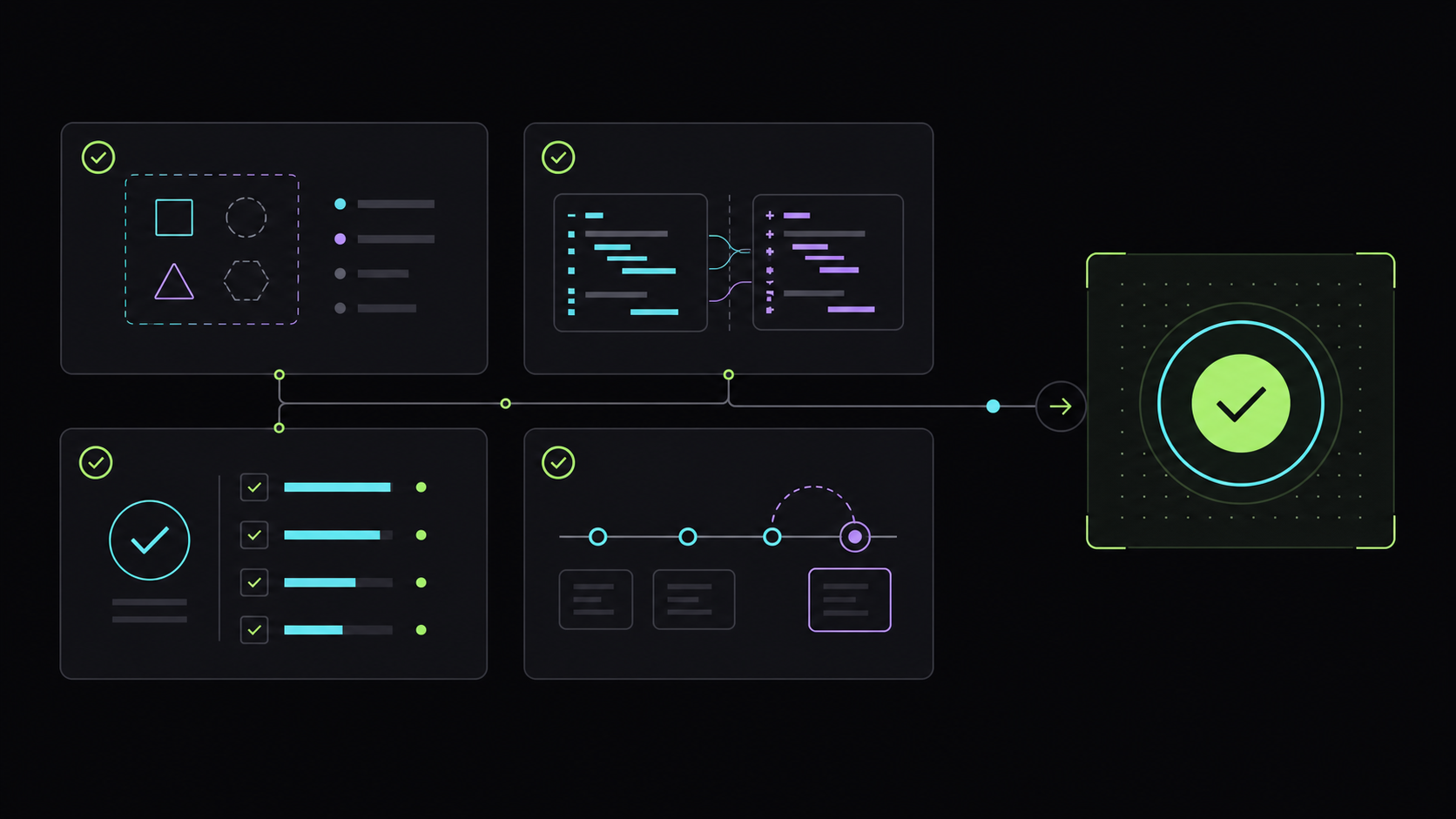
"I ran tests" is better than nothing. "I ran npm run lint and npm test -- StoryDetail, both passed" is reviewable evidence.
Verification should be specific enough that another engineer can reproduce it. The exact command matters. So does the result. If a check fails, the agent should say whether the failure appears related to the change, pre-existing, or unresolved.
Use this verification checklist:
- Relevant automated tests were run.
- Linting or type checks were run when the project supports them.
- UI changes were visually checked when behavior depends on layout.
- API changes were exercised with real request/response evidence.
- Known caveats are named instead of buried.
This is one of the clearest places AI agents can improve developer productivity. The agent can do the boring verification work, capture the commands, and leave the reviewer with a shorter path to trust.
4. Inspect the execution summary
The execution summary is where an AI agent proves it understands what happened.
A useful summary is short and concrete. It should not restate the whole Story. It should tell the reviewer what changed, how it was verified, and what deserves attention. If the summary reads like marketing copy, it is not doing its job.
A strong execution summary includes:
- The specific behavior changed.
- The important files or surfaces touched.
- The verification commands and outcomes.
- Any caveats, follow-ups, or manual review notes.
This is why reviewable AI agent workflows are different from simple code generation. The output is not just a patch. It is a patch plus the context needed to decide whether the patch should ship.
5. Check rollback and failure behavior
Trust improves when a team knows how to recover.
For small product fixes, rollback may be as simple as reverting the pull request. For migrations, background jobs, permissions, billing logic, or integration changes, reviewers need more detail. What happens if the change is wrong? Does it alter data? Does it depend on a new environment variable? Is there a feature flag? Are existing users affected?
An agentic code review checklist should flag higher-risk changes automatically:
- Database migrations and irreversible data changes.
- Auth, billing, permissions, or security-sensitive paths.
- External API integrations.
- Background jobs, queues, and scheduled work.
- Changes that touch shared components or cross-module contracts.
AI coding agents are best used where the review and rollback path is clear. When risk is higher, the agent can still help, but the Story and pull request should make that risk visible.
6. Keep humans on judgment
The point of AI code review is not to remove human judgment. It is to make human judgment easier to apply.
Humans should still decide whether the product behavior is right, whether the tradeoff is acceptable, and whether the change belongs now. Agents can reduce the work around that decision: reading files, drafting the change, running checks, preparing the PR, and collecting evidence.
That division of labor is where AI coding agents become practical for software teams. The agent handles the execution loop. The reviewer keeps ownership of quality.
A simple checklist for your next agent PR
Before merging an AI agent pull request, ask:
- Is the original Story specific enough to judge success?
- Does the diff stay inside the requested scope?
- Does the implementation match the codebase's existing patterns?
- Are verification commands and outcomes listed?
- Are caveats and remaining risks explicit?
- Can the change be reverted or contained if needed?
- Does the reviewer still have enough context to make a real decision?
If the answer is yes, the agent did more than generate code. It produced reviewable software work.
How Evoxiv supports reviewable agentic work
Evoxiv treats AI agent output as part of an engineering workflow, not as a detached assistant response.
Stories define the request. Agents execute in the repo. Pull requests carry the code change. Execution summaries tell reviewers what happened. Reviewers approve or request changes through the same loop. That structure makes AI-assisted development easier to adopt because it fits how teams already ship software.
The SEO phrase is "AI coding agents," but the operational value is accountability. Teams do not need more impressive diffs. They need small, scoped, verified changes that can be reviewed without guesswork.
That is the standard an agentic code review checklist should enforce.